
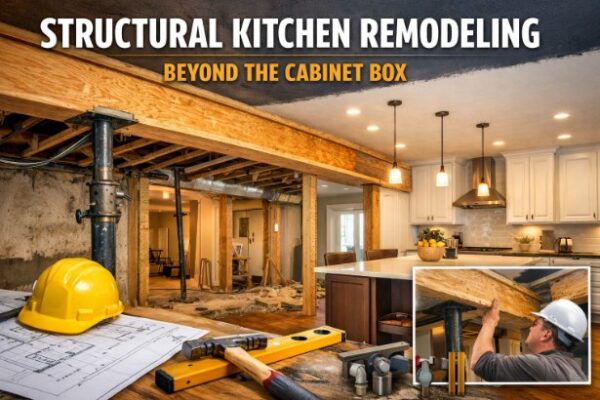
Data last verified: March 2026
Structural kitchen remodeling involves removing load-bearing walls and replacing structural support with engineered beams, such as Laminated Veneer Lumber (LVL).
This process requires load calculations, permit approval, and the coordinated relocation of systems to maintain structural integrity in Huntsville homes.
Huntsville homeowners increasingly prefer open-concept layouts that connect kitchens with living spaces. Open layouts improve natural light distribution, increase usable square footage, and enhance resale value.
In-Design Woodworks operates as a Prime Contractor, managing structural framing, MEP relocation, and finish carpentry within one coordinated scope.
Homeowners planning structural upgrades should review a custom woodworking contractor in Huntsville to align design decisions with structural requirements.
In-Design Woodworks provides structural feasibility assessments for kitchen remodels. Explore home remodeling services in Huntsville to evaluate load paths, beam sizing, and layout options before construction begins.
Open-concept remodeling removes structural barriers and redistributes loads to create a unified living space.
Open-concept remodeling modifies framing systems rather than surface finishes. Removing walls requires replacing structural support with engineered beams.
| Feature | Traditional Kitchen | Open-Concept Kitchen |
| Structure | Enclosed walls | Removed barriers |
| Light | Limited | Expanded |
| Load handling | Wall-based | Beam-based |
The International Code Council requires continuous load paths when structural elements are removed.
Load-bearing wall removal requires a structural analysis to safely transfer loads using engineered beams and supports.
North Alabama homes typically use wood framing with either slab-on-grade or crawlspace foundations. Crawlspace homes allow easier inspection of joists and beams, while slab homes require ceiling-based analysis.
The International Residential Code requires engineered beam sizing and inspections before structural modifications proceed.
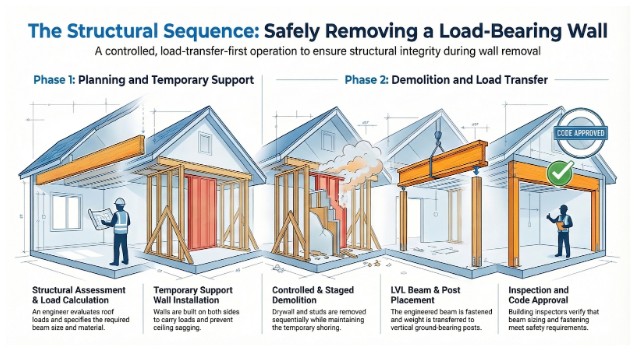
Load-bearing wall removal follows a controlled engineering sequence that preserves structural load paths while transferring weight to a properly sized beam and support system.
Structural wall removal is not demolition-first. Structural wall removal is load-transfer-first. Contractors must maintain continuous support for roof and ceiling loads at every stage of the process.
A contractor or structural engineer evaluates joist direction, roof loads, and span requirements. The engineer specifies beam size, material type, and load transfer points based on calculated loads.
Contractors build temporary support walls on both sides of the existing wall to carry loads during removal. Temporary walls prevent sagging and protect structural integrity during demolition.
Workers remove drywall, studs, and non-structural components in a staged sequence. Contractors avoid sudden load shifts by maintaining temporary support until the beam is fully installed.
Contractors install the engineered LVL beam into the opening using manufacturer-specified fastening schedules. Proper fastening ensures the beam can carry calculated loads without deflection.
Contractors transfer structural loads from the beam into vertical posts or columns. Posts must be aligned with foundation supports or reinforced framing to safely carry loads to the ground.
Local building inspectors verify compliance with beam sizing, fastening, and load transfer requirements. Inspection ensures the project meets International Residential Code (IRC) requirements before finishing work begins.
LVL beams provide engineered strength that supports long spans required for open-concept layouts.
LVL beams are manufactured by bonding wood veneers under pressure, creating consistent structural performance.
| Property | LVL | Solid Lumber |
| Strength | High | Moderate |
| Span | Long | Limited |
| Stability | Consistent | Variable |
Weyerhaeuser provides span tables that engineers use to size beams for specific loads.
MEP systems must be rerouted to maintain functionality after the removal of a structural wall.
Wall removal exposes HVAC ducts, electrical wiring, and plumbing systems.
The National Association of Home Builders emphasizes coordinated planning to avoid system conflicts.
Structural kitchen remodeling follows a controlled construction sequence that maintains load paths, ensures code compliance, and coordinates multiple trades without introducing structural risk.
Structural remodeling requires sequencing because each phase depends on load continuity and system coordination.
Contractors must complete structural reinforcement before removing temporary supports, and MEP relocation before closing walls.
| Phase | Technical Purpose | Risk if Skipped |
| Engineering | Defines load paths and beam sizing | Undersized beam, structural failure |
| Permitting | Verifies compliance with code | Failed inspections, legal issues |
| Temporary support | Maintains load during demolition | Immediate sag or collapse |
| Demolition | Removes structural wall safely | Load shift damage |
| Beam installation | Transfers structural load | Incomplete load path |
| MEP relocation | Restores system functionality | HVAC, plumbing failure |
| Finishing | Restores surfaces and alignment | Visible defects |
The International Code Council requires staged inspections to verify structural integrity before proceeding to the finishing phases.
Proper sequencing reduces rework, prevents delays, and ensures every system functions correctly after structural modification.
Structural remodeling in Huntsville requires adapting to local housing types, foundation systems, and Madison County permitting requirements.
Madison County enforces structural permitting for load-bearing wall removal. Contractors must submit engineered drawings that define beam sizing, load paths, and support placement before approval.
Huntsville housing stock includes ranch-style homes, split-level layouts, and mid-century structures. These homes often rely on central load-bearing walls that support roof systems across long spans.
Local conditions directly affect beam selection, post placement, and construction sequencing. Contractors who understand Huntsville housing patterns reduce risk and improve execution speed.
Homeowners evaluating structural upgrades should review home remodeling in Huntsville to align design decisions with local structural conditions.
A finished integration ensures that structural modifications appear original by matching materials, transitions, and craftsmanship throughout the remodeled space.
Structural remodeling creates discontinuities where walls once existed. Floor systems, trim profiles, and ceiling finishes must be blended to eliminate visible transitions.
Matching hardwood flooring requires species identification, board width alignment, and stain blending. Contractors feather new flooring into existing surfaces to avoid visible seams.
Trim integration requires replicating molding profiles using custom millwork techniques. Crown molding, baseboards, and casings must match original dimensions and profiles to maintain architectural consistency.
Ceiling transitions require texture matching and uniform paint application. Inconsistent textures reveal remodeling work and reduce perceived quality.
For high-precision finish work, homeowners should evaluate residential woodworking in Huntsville to ensure craftsmanship aligns with structural upgrades.
Prime Contractor oversight integrates engineering, permitting, construction, and finishing into a single coordinated system that reduces risk and improves project outcomes.
A Prime Contractor manages all project phases under one scope. This structure eliminates coordination gaps between trades and ensures accountability across structural, mechanical, and finish work.
Prime Contractor oversight ensures that beam installation aligns with engineering plans, MEP systems integrate correctly, and finish carpentry meets design expectations.
In-Design Woodworks provides full-scope structural remodeling with engineering coordination and finish precision. Schedule your consultation to plan your project with expert oversight.
| Factor | DIY Execution | Prime Contractor Execution |
| Structural safety | High failure risk | Engineered load transfer |
| Code compliance | Unverified | Inspection-approved |
| Timeline | Fragmented | Coordinated |
| Finish quality | Inconsistent | Integrated |
Prime Contractor management reduces structural risk and ensures the finished space meets both engineering and design standards.
Structural kitchen remodeling increases usable space, improves daily functionality, and enhances long-term property value when executed with proper engineering.
Open-concept kitchens improve circulation between living areas and increase natural light penetration. Improved layout efficiency enhances usability for cooking, entertaining, and daily living.
Real estate data consistently shows that open-concept kitchens increase buyer demand and perceived home value. Structural remodeling delivers measurable return on investment when executed correctly.
Structural improvements also reduce long-term maintenance issues by replacing outdated framing and improving the efficiency of system layout.
In-Design Woodworks builds structurally engineered kitchens designed for long-term performance. Book your consultation through the contact page and start your remodel with confidence.
A structural kitchen remodel modifies load-bearing elements, such as walls and beams, to change the layout and improve space. Structural remodeling requires engineering analysis, permits, and coordinated construction to ensure safety and compliance.
A load-bearing wall typically runs perpendicular to floor joists, supports roof structures, or aligns with foundation supports. A structural inspection confirms whether a wall carries load before removal.
An LVL beam is an engineered wood product made from laminated veneers that provides high strength and consistent performance. LVL beams support wide openings required for open-concept remodeling.
Structural wall removal requires permits under local building codes. Authorities enforce International Residential Code standards and require inspections during construction to ensure compliance.
Structural kitchen remodeling typically takes several weeks, depending on the scope. The process includes engineering, permitting, demolition, structural reinforcement, system relocation, and finishing work.
Plumbing can be relocated by rerouting supply and drain lines. Proper slope and venting ensure drainage performance and code compliance.
Open-concept remodeling increases usable space, improves natural light, and enhances property value. Proper engineering ensures long-term structural performance.
A Prime Contractor manages all aspects of a remodeling project, including engineering, subcontractors, permits, and inspections, ensuring coordination and quality control.
Improper removal disrupts structural load paths and can cause sagging ceilings, cracking, or collapse. Engineered reinforcement prevents these issues.
LVL provides higher strength, longer spans, and consistent performance, making it more reliable for structural applications than traditional lumber.