
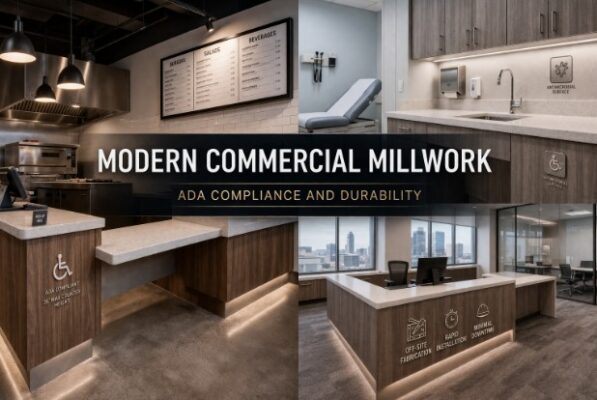
Data last verified: March 2026
Commercial millwork in Huntsville, AL, must meet the 2010 ADA Standards for Accessible Design, which require service counters no higher than 34 inches above the finished floor (AFF) and at least 27 inches of knee clearance for seated access.
High-traffic environments — restaurants, medical offices, and corporate lobbies — require materials such as High-Pressure Laminate (HPL), solid surface, or fire-rated substrates engineered for continuous wear.
In-Design Woodworks fabricates commercial casework off-site and installs it in compressed windows to minimize disruption to Huntsville businesses.
Commercial millwork is not a one-size-fits-all proposition.
A restaurant counter endures spilled liquids, impacts, and constant cleaning. A medical reception desk must withstand exposure to pathogens and comply with infection-control standards.
A corporate lobby installation projects brand identity while accommodating every visitor, including those with mobility challenges. The specifications governing each of these environments are distinct, technical, and consequential.
Commercial millwork differs from residential work primarily in durability requirements, code obligations, and scale. Where a residential cabinet sees moderate daily use, a restaurant counter or hospital reception desk faces continuous traffic, chemical exposure, and strict regulatory oversight that residential-grade products cannot withstand.
Residential cabinetry is designed around aesthetics and moderate use. The homeowner choosing a kitchen cabinet finish prioritizes appearance, because a household cabinet faces a fraction of the daily interactions a commercial installation endures.
Commercial millwork inverts that priority without abandoning beauty: durability, compliance, and material performance come first, and skilled millworkers deliver those qualities within a design that still elevates the space.
The distinctions matter practically. Residential-grade particleboard substrates absorb moisture over time in a high-humidity commercial kitchen.
Standard laminate surfaces scratch and delaminate under the cleaning chemicals required in medical environments. Edge banding that looks fine in a home office separates quickly under the continuous impact of a busy retail counter.
Huntsville businesses that invest in properly specified commercial millwork avoid costly replacements and the operational disruptions that come with them.
In-Design Woodworks works with restaurants, medical practices, corporate offices, retail stores, churches, educational institutions, and government facilities across the Huntsville area.
Each project begins with an honest assessment of how the space will be used, who will use it, and what performance standards the installation must meet. Whether the project involves new construction or a full commercial remodel, the specification process is the same.
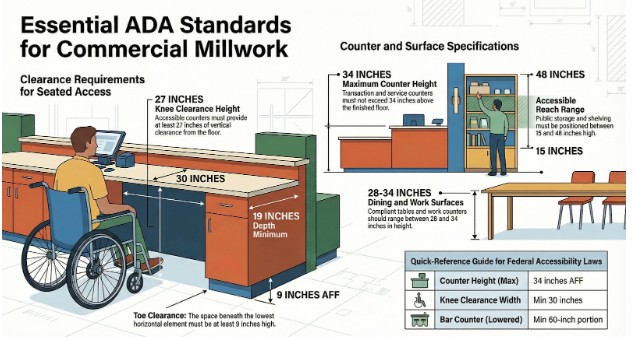
The ADA Standards Section 306 requires that accessible counters provide knee clearance of at least 27 inches, 30 inches wide, and 19 inches deep, with toe clearance of at least 9 inches AFF.
Service counters must not exceed 34 inches AFF. These dimensions must be designed into commercial millwork before fabrication begins — retrofitting a non-compliant counter is significantly more expensive than building compliance in from the start.
The Americans with Disabilities Act is federal law, and its architectural standards apply to any place of public accommodation, which includes virtually every commercial space in Huntsville.
For millwork, the standards translate into specific dimensional requirements that must be built into the design before fabrication begins. Retrofitting a non-compliant counter after installation is expensive; designing compliance in from the start is not.
When a counter is intended for seated use or must be accessible to wheelchair users, ADA Standards Section 306.3 specifies the clearance geometry precisely. Knee clearance must reach at least 27 inches in height from the floor, extend at least 19 inches in depth, and span at least 30 inches in width.
This geometry allows a wheelchair user to position themselves directly at the counter surface rather than reaching from an awkward angle.
Toe clearance — the space beneath the lowest horizontal element — must provide at least 9 inches of height from the finished floor and extend at least 17 inches under the structure.
In a medical reception environment or a bank teller station, that access is not optional; it is required. In-Design Woodworks designs to these dimensions for every Huntsville commercial project involving public-facing counters.
The accessible counter height maximum of 34 inches AFF applies to transaction counters, service counters, and any work surface intended for public use. This is lower than the typical 36-inch residential counter, and the difference requires intentional planning when a commercial installation blends accessible and standard-height sections.
Universal design goes beyond minimum ADA compliance. A medical waiting room that serves elderly patients with limited mobility benefits from lower shelving, easy-grip hardware, and built-in seating recesses throughout the space.
In-Design Woodworks routinely designs and fabricates to these specifications for Huntsville medical and office millwork projects.
| ADA Element | Specification | Applies To |
| Counter height (max) | 34 inches AFF | Service counters, reception |
| Knee clearance height | Min 27 inches AFF | Seated-use counters |
| Knee clearance depth | Min 19 inches | Accessible workstations |
| Knee clearance width | Min 30 inches | All accessible counters |
| Toe clearance height | Min 9 inches AFF | Beneath counters and cabinets |
| Reach range (forward) | 15 to 48 inches AFF | Storage, shelving |
| Dining/work surface height | 28 to 34 inches AFF | Tables, work counters |
| Bar counter lowered section | Min 60-inch accessible portion | Restaurant bar areas |
Source: U.S. Access Board — Chapter 9: Built-In Elements. AFF = above finished floor.
High-Pressure Laminate (HPL) offers broad design flexibility and impact resistance for restaurants and retail. Solid surface materials like Corian and engineered quartz deliver seamless, non-porous counters essential for food service and medical environments.
Fire-rated substrates with antimicrobial finishes meet life-safety codes and infection-control requirements in healthcare settings across Huntsville.
High-Pressure Laminate is manufactured by fusing multiple layers of kraft paper saturated with phenolic resin under heat and pressure, then bonding a decorative layer to the surface.
The result resists impacts, scratches, and a wide range of cleaning chemicals, making it the most widely specified commercial surface material in restaurant, retail, and light office applications.
HPL is available in hundreds of patterns and colors, including wood-grain and stone appearances that suit premium commercial interiors.
The limitation of HPL is its seams. Where two panels meet, the joint is visible and can harbor moisture over time.
In food-service environments where seamless cleanability is a hygiene requirement, or in medical settings where infection-control standards demand a non-porous, gap-free surface, solid surface materials are the correct specification.
Solid surface materials, including Corian and engineered quartz composites, can be thermoformed and joined with inconspicuous seams.
Surface damage can be sanded and buffed out rather than requiring full panel replacement. Their non-porous structure resists bacteria and is compatible with the cleaning protocols required in medical and food-preparation environments.
In-Design Woodworks helps Huntsville clients evaluate the right specification for their space through the commercial woodworking consultation process.
Medical facilities and many public buildings in Huntsville are required by the International Building Code and Alabama fire codes to use fire-rated millwork substrates in specified occupancy areas.
Fire-rated particleboard and MDF substrates contain fire-retardant chemical treatments that slow the spread of flame. These substrates carry a Class A fire rating and are specified by architects on projects where the building classification requires it.
Certain HPL products are manufactured with silver-ion antimicrobial additives in the surface layer, providing continuous inhibition of bacterial growth between cleaning cycles. These products are widely used in hospital casework, clinic reception areas, and dental offices.
Hardware choices carry infection-control implications, too: touch-free pull hardware, antimicrobial-coated hinges, and flat-panel door profiles reduce the number of surfaces requiring manual disinfection.
Specifying these elements at the design stage is the approach In-Design Woodworks brings to every Huntsville medical millwork project.
| Material | Durability | Best Use |
| High-Pressure Laminate (HPL) | Excellent impact resistance | Restaurants, retail counters |
| Solid Surface (Corian/Quartz) | Seamless, non-porous | Medical, food service |
| Phenolic Resin Core | Moisture and impact resistant | Labs, high-humidity areas |
| MDF with HPL Overlay | Good for moderate traffic | Offices, light commercial |
| Fire-Rated Substrate | Class A FR rating | Medical, public buildings |
Contact In-Design Woodworks at 256.701.4542 to specify fire-rated or antimicrobial commercial millwork for your Huntsville medical or commercial facility.
Commercial millwork projects minimize business downtime through off-site fabrication: cabinets, counters, and built-ins are fully constructed in the shop, then delivered and installed in concentrated windows.
A well-managed installation for a Huntsville restaurant or medical office can be completed during off-hours or a planned closure, avoiding prolonged disruption to daily operations.
Unlike on-site carpentry, where cutting, sanding, and finishing occur in the business space over days or weeks, commercial millwork fabrication takes place in the controlled environment of the woodworking shop.
Panels are cut to precise dimensions, edges banded and finished, doors hung and adjusted, and hardware installed before any piece leaves the shop. What arrives at the Huntsville job site is ready to be set in place and connected.
That approach dramatically compresses the on-site installation window. A restaurant that would otherwise face a two-week partial closure for on-site construction can often schedule a weekend installation of shop-fabricated millwork and reopen Monday morning.
Medical practices can schedule installation during a planned closure or over a holiday week. In-Design Woodworks has served commercial clients across Huntsville, from restaurant fixtures and bar seating to full corporate lobby installations.
Most commercial millwork projects in Huntsville occur within a larger renovation or new-construction scope that involves general contractors, interior designers, and MEP subcontractors.
In-Design Woodworks coordinates directly with project stakeholders to align the fabrication and delivery schedule with the construction timeline, ensuring that cabinets and counters arrive when the space is ready to receive them.
Interior designers working on Huntsville commercial projects are encouraged to contact In-Design Woodworks early in the design process.
Providing millwork design intent during the schematic phase allows the fabrication team to identify material lead times, flag ADA or code conflicts, and accurately price the work before the construction documents are finalized.
Contractors seeking a reliable commercial millwork partner can review In-Design Woodworks’ background and capabilities before reaching out.
In-Design Woodworks partners with Huntsville contractors and designers on commercial casework. Call 256.701.4542 to request a commercial millwork bid. Mon–Sat, 7 AM–5 PM.
Commercial millwork covers custom counters, casework, and built-ins fabricated for non-residential environments. It differs from residential cabinetry in substrate durability, surface specifications, and code compliance requirements. In-Design Woodworks provides residential and commercial woodworking services throughout Huntsville.
ADA Standards apply to any place of public accommodation in Huntsville. At a minimum, a portion of the service counters must meet the accessible-height and knee-clearance requirements under ADA Chapter 9, Built-In Elements. A certified accessibility consultant provides site-specific guidance.
HPL over moisture-resistant substrates is suitable for most restaurant surfaces. Solid surface or quartz is specified where seamless, non-porous performance is required. In-Design Woodworks reviews material requirements at the start of every commercial woodworking project in Huntsville.
Off-site fabrication typically takes two to six weeks after design approval. On-site installation for a single commercial space can often be completed in one to three days. Contact In-Design Woodworks at indesignwoodworks.com/contact to discuss your Huntsville project schedule.
Yes. In-Design Woodworks regularly collaborates with Huntsville architects, designers, and contractors. Early involvement allows the team to flag code requirements and accurately price the work. Visit the About Us page to review the company’s commercial project experience.
Yes. In-Design Woodworks provides remodeling services that include replacing existing millwork, reconfiguring layouts for ADA compliance, and refinishing existing wood pieces. Call 256.701.4542 to request a Huntsville commercial remodeling estimate.
In many commercial occupancy classifications, Alabama’s adopted IBC requires fire-rated substrate materials. Requirements depend on the occupancy category and the project’s construction documents. In-Design Woodworks fabricates to specified fire-rated requirements for medical, restaurant, and office millwork projects.