
Data last verified: March 2026
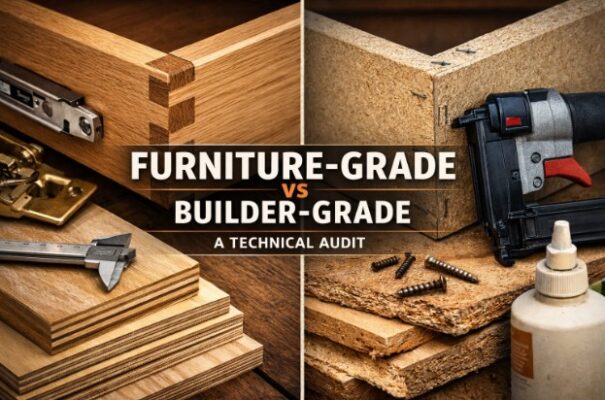
Furniture-grade cabinetry uses dense hardwoods, engineered joinery, and 3/4″ plywood construction to maintain structural alignment over long-term use.
Builder-grade cabinetry relies on particleboard, stapled joints, and low-cycle hardware, which compromises durability and performance.
Cabinet quality is defined by construction method, not appearance. Two cabinets can look identical at installation but diverge in performance within one to two years. In-Design Woodworks builds cabinetry as structural furniture systems rather than modular boxes.
Furniture-grade cabinetry is a structural classification based on material density, joinery mechanics, and long-term dimensional stability.
Furniture-grade cabinetry functions as a load-bearing system. Cabinet boxes, drawers, and doors must resist deformation under weight, repeated use, and environmental change.
Hardwood species such as maple and cherry provide high density, which improves screw holding strength and resistance to compression. Dense materials maintain joint integrity under repeated loading conditions.
Material performance data from the Wood Handbook: Wood as an Engineering Material confirms that higher-density wood improves fastener holding capacity and structural stability.
Low-density composite materials compress under load, which leads to joint loosening and long-term deformation.
Furniture-grade cabinetry uses joinery systems that transfer load across surfaces rather than concentrating stress at fasteners.
Builder-grade cabinets use staples and pins. These methods rely on localized fastener strength, which weakens over time.
Joinery determines whether a cabinet maintains alignment or gradually fails under daily use.
| Attribute | Furniture-Grade | Builder-Grade |
| Material | Hardwood/plywood | Particle board / MDF |
| Joinery | Dovetail, mortise & tenon | Staples, pins |
| Load behavior | Distributed | Concentrated |
| Lifespan | 15–25+ years | 5–10 years |
Furniture-grade cabinetry is defined by structural performance, not visual styling.
Cabinet quality follows a hierarchy based on materials, joinery, and manufacturing precision, with fully custom systems delivering the highest structural performance.
Cabinet construction exists on a performance spectrum. Each level reflects trade-offs between cost, material integrity, and long-term durability.
Builder-grade cabinets are manufactured for cost efficiency. Manufacturers use particle board boxes, thin back panels, and stapled joinery to reduce production time.
Typical limitations include:
These cabinets perform adequately at installation but degrade under repeated use and environmental exposure.
Semi-custom cabinetry introduces selective upgrades such as improved finishes or optional plywood boxes. Structural design and joinery methods often remain unchanged.
Performance improves marginally, but long-term structural limitations persist.
Fully custom cabinetry is built from raw materials with no size or construction constraints. Fabrication prioritizes structural integrity, precision alignment, and material consistency.
| Tier | Materials | Joinery | Performance |
| Builder-Grade | Particle board | Stapled | Short lifespan |
| Semi-Custom | Mixed materials | Partial upgrades | Moderate |
| Furniture-Grade | Hardwood + plywood | Engineered joinery | Long-term stability |
Fully custom systems maintain alignment, resist deformation, and perform consistently over extended use cycles.
Cabinet box construction determines structural lifespan, with 3/4″ plywood providing superior strength, moisture resistance, and fastener retention.
Cabinet boxes carry the entire load of the system. Structural failure begins at the box level.
Plywood uses cross-laminated veneers that distribute load across multiple layers. This structure resists bending and maintains dimensional stability.
Particle board consists of compressed fibers bonded with resin. Particle board lacks an internal grain structure, which reduces its strength and increases the risk of failure under load.
| Property | 3/4″ Plywood | Particle Board |
| Load capacity | High | Moderate |
| Screw retention | Strong | Weak |
| Moisture resistance | Moderate–high | Low |
| Failure mode | Gradual deformation | Sudden breakdown |
3/4″ plywood provides sufficient thickness to resist flex and hold fasteners under repeated stress. Thinner materials deflect, which causes drawer misalignment and door sagging over time.
Domestic maple plywood provides consistent veneer quality and structural reliability compared to lower-grade alternatives.
UV-coated cabinet interiors improve durability, hygiene, and chemical resistance compared to raw or low-grade melamine interiors used in builder-grade cabinetry.
Cabinet interiors are functional surfaces exposed to abrasion, spills, and cleaning chemicals. Interior finish quality determines long-term usability, not appearance.
UV-cured coatings create a hardened finish through photochemical curing. This process produces a dense, cross-linked surface that resists scratching, staining, and chemical exposure.
According to RadTech UV curing technology standards, UV coatings form durable finishes with superior resistance compared to air-dried coatings.
Raw interiors absorb moisture and stains. Melamine interiors resist moisture but can chip at the edges, exposing the substrate.
UV-coated interiors create non-porous surfaces that prevent bacterial buildup and residue accumulation. Smooth finishes allow easy cleaning without surface degradation.
Raw wood interiors trap moisture and contaminants within the grain structure. Over time, this leads to odor retention and surface discoloration.
| Property | UV-Coated Interior | Raw / Low-Grade Interior |
| Moisture resistance | High | Low |
| Chemical resistance | High | Moderate–low |
| Cleanability | Easy | Difficult |
| Wear resistance | High | Moderate |
Joinery determines structural integrity, with dovetail drawers and mortise-and-tenon frames providing superior load distribution and long-term alignment.
Joinery is the primary factor that determines whether cabinetry maintains structural alignment under repeated use.
Dovetail joints interlock drawer sides mechanically. The joint resists pulling forces created by the drawer opening and closing.
Stapled or pinned drawers rely on fasteners and adhesive. These joints weaken as fasteners loosen under repeated stress cycles.
| Joinery Type | Load Resistance | Failure Mode |
| Dovetail | High | Gradual wear |
| Stapled / Pinned | Low | Joint separation |
Dovetail construction converts tensile force into compressive force across the joint, which improves durability.
Mortise-and-tenon joinery connects door rails and stiles through interlocking geometry. This joint distributes load across the entire connection surface.
The Wood Handbook: Wood as an Engineering Material explains that larger bonding surfaces improve joint strength and resistance to mechanical stress.
Builder-grade doors often use cope-and-stick joints or dowels. These joints provide less surface area and fail under long-term stress.
Joinery determines whether a cabinet maintains alignment after thousands of use cycles. Fasteners can loosen. Proper joinery distributes load and prevents structural failure.
Builder-grade cabinets cost less upfront but require replacement sooner, while furniture-grade cabinetry has a higher initial cost but offers a significantly longer lifespan and better long-term value.
Cabinet pricing reflects material quality, joinery method, and hardware performance. Lower upfront cost typically indicates reduced material density and simplified construction.
| Cabinet Type | Typical Cost Range (Kitchen) | Construction Level |
| Builder-Grade | $5,000 – $12,000 | Particle board, stapled joinery |
| Semi-Custom | $12,000 – $20,000 | Mixed materials |
| Furniture-Grade Custom | $20,000 – $40,000+ | Hardwood, engineered joinery |
Builder-grade cabinets reduce cost by using lower-density materials and faster assembly methods. Custom cabinetry increases cost due to labor, material quality, and precision fabrication.
| Factor | Builder-Grade | Furniture-Grade |
| Lifespan | 5–10 years | 15–25+ years |
| Repair frequency | High | Low |
| Replacement cycle | 1–2 times in 20 years | Typically none |
| Structural failure risk | High | Low |
Builder-grade cabinets often require replacement within one decade. Furniture-grade systems maintain structural performance across multiple decades.
| Scenario | Total Cost |
| Replace builder-grade twice | $10,000 × 2 = $20,000 |
| Install furniture-grade once | $25,000 (average) |
The cost difference narrows when replacement cycles are considered. Furniture-grade cabinetry provides stability and avoids disruption from repeated renovations.
Lower upfront cost often results in higher long-term expense due to these indirect factors.
Furniture-grade cabinetry provides:
High-end buyers recognize construction quality, not just visual appearance.
High-end cabinetry uses precision-engineered hardware systems such as Blum and Salice to ensure smooth operation, load control, and long-term reliability.
Hardware systems control movement. Movement introduces wear, and wear determines lifespan.
Soft-close systems use hydraulic dampers to control closing speed and prevent impact. High-end systems synchronize motion to ensure consistent closure regardless of load variation.
Inferior systems rely on basic dampers that degrade quickly and lose effectiveness.
| Feature | Blum | Salice |
| Cycle rating | Up to 200,000 cycles | Up to 100,000+ cycles |
| Motion control | Integrated soft-close | Integrated soft-close |
| Adjustability | Multi-axis adjustment | Multi-axis adjustment |
| Precision | High | High |
Blum hardware systems are widely used in premium cabinetry and are engineered for long-term durability.
Salice systems also provide high-performance solutions, particularly in European-style cabinetry, as outlined by Salice hardware systems.
Hardware failure leads to:
Hardware must match the cabinet’s structural quality. High-end joinery with low-grade hardware creates an imbalance in the system.
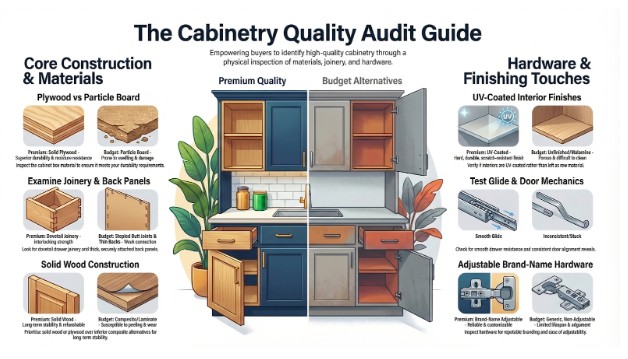
Buyers can evaluate cabinetry quality by inspecting materials, joinery, hardware, and finishes before purchase.
Cabinet quality can be verified through physical inspection. Most structural differences are visible with basic evaluation.
In-Design Woodworks builds cabinetry using furniture-grade materials, precision joinery, and engineered hardware systems. Review custom woodworking capabilities to choose cabinetry designed for long-term performance.
Furniture-grade cabinets use hardwood materials, precision joinery, and engineered hardware to maintain structural alignment over time. Builder-grade cabinets rely on particle board and fasteners, which reduces durability and leads to faster wear and failure.
Plywood cabinets offer greater strength, better screw retention, and improved moisture resistance than particle board. Particle board cabinets degrade when exposed to moisture and lose structural integrity more quickly under repeated loading.
Builder-grade cabinets typically last 5 to 10 years, depending on usage and environmental conditions. Structural components such as particle board boxes and stapled joints degrade over time, leading to alignment issues and functional failure.
Dovetail drawers use interlocking joints that distribute pulling forces across the entire joint surface. Stapled drawers rely on fasteners that loosen over time, leading to joint separation and reduced long-term durability.
Cabinet box construction supports the entire system, including drawers, doors, and countertops. Weak box materials cause structural failure, misalignment, and hardware stress, which reduces overall cabinet lifespan regardless of finish quality.
UV-coated cabinet interiors use cured finishes that resist moisture, stains, and chemical exposure. These surfaces improve hygiene, increase durability, and prevent long-term degradation compared to raw or low-grade interior finishes.
High-quality cabinets show dovetail drawer construction, plywood box materials, smooth hardware operation, consistent door alignment, and durable interior finishes. Physical inspection of these elements reveals structural quality beyond surface appearance.
Soft-close hinges improve durability by reducing impact stress during closing cycles. High-quality systems maintain consistent performance over thousands of cycles, while low-grade hinges lose damping performance and affect door alignment.
The biggest mistake is evaluating cabinets based on appearance instead of construction. Surface finishes can hide weak materials, poor joinery, and low-grade hardware that fail under long-term use.
Custom cabinets last longer because custom fabrication uses higher-quality materials, engineered joinery, and precision hardware. These factors improve structural stability and reduce wear compared to mass-produced stock cabinetry.