
Data last verified: March 2026
Inset cabinetry is the benchmark of custom residential woodworking — the construction detail that separates a truly crafted kitchen or bath from a production-grade installation.
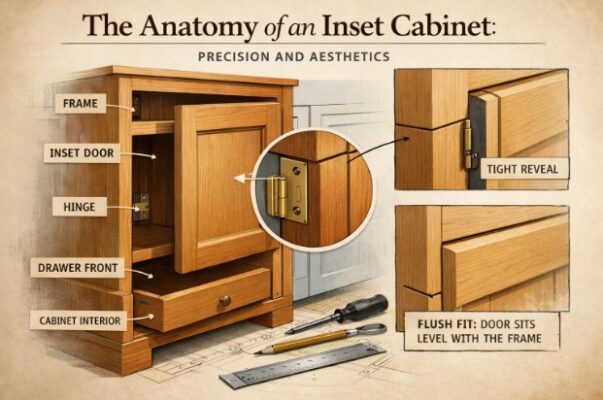
Inset doors sit flush within the face-frame opening, creating a continuous, unbroken surface along the entire run of cabinetry. Standard overlay doors mount in front of the face frame, concealing the frame edges behind the door face.
Huntsville homeowners investing in custom residential woodworking at In-Design Woodworks choose inset cabinetry as the highest-precision expression of the craft.
Every face frame, door, drawer front, and hinge must be cut, fitted, and installed to tolerances measured in fractions of an inch. No overlay exists to conceal a gap or absorb a misalignment.
Inset cabinetry is a cabinet construction method in which door and drawer fronts are set inside the face frame opening rather than mounted over it. When closed, an inset door face sits in the same plane as the face frame — no overlap, no projection, no shadow gap between the door and the frame.
The reveal — the narrow, consistent gap between the door edge and the face frame — is the defining visual signature of inset construction. The reveal must be consistent, intentional, and dimensionally stable across years of seasonal humidity change.
An inset door that fits cleanly in January and binds against the face frame in August, because the wood swells in North Alabama’s summer humidity, represents a fabrication failure, not a material limitation.
Full-overlay cabinetry — the dominant style in American residential construction — covers nearly the entire face frame with the door, leaving only a few millimeters of frame visible between adjacent doors.
Full-overlay construction tolerates small variations in door sizing and hinge placement because the door face conceals those variations. Full-overlay cabinetry dominates American residential construction because it produces consistent results faster and at lower cost than inset construction.
Partial-overlay cabinetry covers the face frame opening plus a portion of the surrounding frame, leaving a wider band of frame visible between adjacent doors. Partial overlay is associated with traditional and transitional kitchen styles produced from the 1940s through the 1980s and remains standard in entry-level and mid-range production cabinetry lines.
Inset cabinetry reverses the construction geometry entirely. The door must fit the opening precisely, with a uniform reveal gap on all four sides.
Every fabrication decision — face frame squareness, door thickness, hinge placement — is visible in the finished installation.
For custom woodworking in Huntsville, inset construction is the standard that distinguishes production cabinet lines from true custom fabrication.
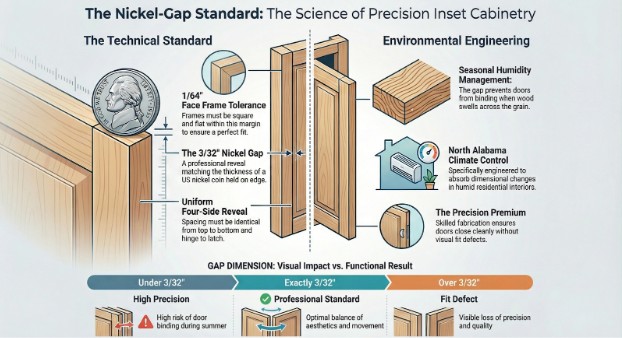
Inset cabinetry demands fabrication and installation tolerances that exceed those of any other residential cabinet style. The face frame must be square and flat to within 1/64″ across its full length.
The door must be milled to the exact dimensions of the opening, minus the intended reveal, on all four sides. The hinge must position the door so that the reveal is uniform from top to bottom and from hinge stile to latch stile.
These tolerances must hold not just at installation but across years of seasonal wood movement driven by North Alabama’s humidity cycle.
Inconsistent reveals are immediately visible to any observer. An inset door that binds or fails to close cleanly due to fabrication tolerances not being maintained is a functional failure.
These standards are why inset cabinetry commands a price premium over overlay construction and why individual woodworker skill determines outcome quality in inset work far more directly than in any overlay style.
The professional standard for inset cabinet reveals is a uniform gap of 3/32″ on all four sides of every door and drawer front.
Cabinet makers call this the nickel gap because a 3/32″ gap equals approximately the thickness of a United States nickel coin held on edge — a coin many cabinet makers carry as a field gauge during fitting and installation.
The 3/32″ dimension is functionally specific. A gap narrower than 3/32″ risks the door binding against the face frame during peak summer humidity, when wood swells across the grain. A gap wider than 3/32″ reads visually as a fit defect rather than a precision reveal.
The 3/32″ standard balances optical precision with the dimensional tolerance needed to absorb seasonal wood movement in climate-controlled North Alabama interiors.
Maintaining consistent nickel gaps across a full run of cabinetry requires that every component — face frame member, door, drawer box, and drawer front — be milled, fitted, and hung to the same standard applied uniformly across the installation.
In-Design Woodworks holds the nickel-gap standard on every custom residential cabinetry project in Huntsville.
Wood is a hygroscopic material: wood fibers absorb atmospheric moisture when relative humidity rises and release moisture when relative humidity falls, expanding across the grain during absorption and contracting during release.
In full-overlay cabinetry, seasonal wood movement is functionally invisible — the door shifts slightly but still covers the opening. In inset cabinetry, the same movement directly reduces or widens the reveal gap.
A door that shrinks 1/32″ during a dry heating season creates a visibly uneven reveal; a door that swells 1/16″ during a humid summer can bind hard against the face-frame stile.
Managing wood movement in inset cabinetry begins with material selection, before any component is cut. Quartersawn lumber — in which annual growth rings run roughly perpendicular to the face of the board — exhibits 30 to 50 percent less across-the-grain movement than flatsawn lumber cut from the same species.
According to the USDA Forest Products Laboratory Wood Handbook, General Technical Report FPL-GTR-282 (2021), it is the preeminent federal reference on wood as an engineering material. Cabinet makers specify quartersawn white oak, quartersawn hard maple, and quartersawn cherry for inset door stiles and rails in humid climates for this reason.
Dimensionally stable sheet goods — medium-density fiberboard (MDF) and void-free hardwood plywood — are specified for door panels and face frame components where movement must be minimized.
In-Design Woodworks engineers seasonal movement tolerance into every custom remodeling and new-build cabinetry project in Huntsville, sizing components to the specific wood species and the relative humidity range of North Alabama interiors — typically 35 to 65 percent RH across seasons.
Inset cabinetry built to this specification holds its reveals consistently through summer humidity peaks and winter heating-season dryness without binding or gapping.
Ready to see the nickel-gap standard applied in your kitchen? Call In-Design Woodworks at 256.701.4542 to discuss your custom cabinetry specifications.
Inset cabinetry divides into two distinct construction variants — beaded inset and plain inset — each carrying a specific architectural identity and a defined set of compatible hardware families.
The choice between beaded and plain inset determines the visual register of the entire kitchen or bath installation and must be resolved early in the design sequence, before face frame profiles are milled.
Both variants share the same core construction logic: the door sits flush within the face frame opening, and the reveal gap holds at a consistent 3/32″. The variants differ in the profile applied to the interior perimeter of the face frame opening.
Beaded inset cabinetry is a cabinet construction variant in which a narrow decorative molding — called a bead — is routed or applied around the interior perimeter of each face frame opening.
The bead measures 3/16″ to 1/4″ in width, projects slightly from the face frame surface, and creates a shadow line that visually frames each door opening. The bead articulates each opening as a distinct architectural element.
Beaded inset is the period-correct specification for kitchens and bathrooms in homes built in traditional American architectural styles, including Colonial Revival, Craftsman, Federal, Georgian, and Victorian. Beaded inset is also the appropriate specification for Huntsville homes undergoing period-sensitive remodeling, where new cabinetry must visually integrate with existing architectural millwork — detailed door casings, chair rails, wainscoting, or built-in cabinetry from the original construction period.
Beaded inset cabinetry reads as a continuation of the same decorative grammar already present in the trim package.
Plain inset cabinetry is a cabinet construction variant that omits the bead profile entirely, leaving the face frame opening with a clean, square interior edge. The reveal gap defines the border of the door opening with no additional ornamentation.
Plain inset is the specification for contemporary, modern farmhouse, transitional, and minimalist interiors. Plain inset pairs with slab-front door profiles, flat-panel shaker doors, and hardware with clean geometric lines — matte black pulls, satin bar handles, and recessed cup pulls.
A beaded inset installed in a contemporary home reads as an architectural inconsistency. Plain inset installed in a period home reads as an omission.
In-Design Woodworks guides Huntsville homeowners through this specification decision by evaluating the home’s existing trim language against the renovation’s design intent.
Hardware specification for inset cabinetry is a structural design decision, not a finish selection. Inset doors require a hinge that mounts simultaneously to the face frame edge and the door edge.
The hinge must be specified before face frame and door fabrication begins because the hinge type determines the mortise geometry cut into both components. The two primary hinge families for inset cabinetry are exposed finial butt hinges and concealed European cup hinges.
Exposed finial butt hinges — a hinge type in which the barrel and decorative finial tip are visible on the face of the installation — mount on the face frame surface and the door edge, making the hinge a visible design element.
The finial tip, a small turned or cast ornament at the top and bottom of each hinge barrel, is a defining signature of traditional American custom cabinetry. Finial butt hinges are available in unlacquered brass, oil-rubbed bronze, antique nickel, and hand-forged black iron finishes.
Unlacquered brass signals a warm, traditional character; oil-rubbed bronze signals a craftsman and rustic character; antique nickel signals a transitional character.
Concealed European cup hinges — a hinge type originally engineered for overlay cabinetry and adapted for inset applications — mount inside a 35mm bored cup hole in the back face of the door and clip to a mounting plate on the inside face of the face frame.
No hinge mechanism is visible when the door is closed. Concealed European cup hinges also provide three-axis adjustment after installation, allowing the door position to be corrected in height, depth, and lateral position without removing and remounting the hinge.
In-Design Woodworks sources hinge hardware to match the design intent of each custom cabinetry project in Huntsville — specifying exposed brass finial butt hinges for historic craftsman kitchens and concealed European cup hinges for contemporary and minimalist bath installations.
Custom inset cabinetry is a residential renovation investment that produces measurable effects on both appraised property value and buyer perception at the point of sale.
Inset cabinetry is one of the few kitchen finishes that residential appraisers, real estate staging professionals, and experienced buyers can each identify independently as evidence of custom-grade construction rather than production-grade construction.
Residential appraisers applying the Uniform Residential Appraisal Report (URAR) methodology assess kitchen and bath finish quality using a rating scale that distinguishes among production, semi-custom, and custom construction.
Custom-grade kitchen construction supports higher quality ratings in appraisal reports, and those ratings flow directly through to appraised property value.
Inset cabinetry — because it requires individually fitted components held to tolerances that no production line achieves — is the single most identifiable indicator of custom-grade kitchen construction in a residential appraisal.
A kitchen with full-inset cabinetry, period-correct hardware, and quality stone countertops supports a custom-quality rating under the URAR methodology.
An otherwise identical kitchen with standard full-overlay cabinetry typically supports only a semi-custom rating — a distinction that carries through to the property’s appraised value.
The National Association of Realtors 2022 Remodeling Impact Report ranks complete kitchen renovations among the highest-return remodeling projects for resale value recovery.
Within the kitchen renovation scope, cabinetry quality tier is the single largest driver of both project cost and perceived value at appraisal. Specifying custom inset cabinetry rather than semi-custom overlay directly improves the return profile of the entire renovation investment.
Huntsville homeowners listing properties priced at $450,000 and above occupy a market segment where experienced buyers identify custom finishes at showings and respond to their presence.
A home in this price tier with production full-overlay cabinetry in an otherwise high-quality renovation creates a visible quality inconsistency that experienced buyers register as a negotiating signal.
Custom inset cabinetry removes that inconsistency and supports the home’s price positioning during the appraisal and inspection process.
In-Design Woodworks collaborates with Huntsville homeowners, interior designers, and real estate professionals to specify custom residential cabinetry matched to the price tier and renovation objective of each property.
What is the difference between inset and overlay cabinetry?
Inset cabinetry sets door, and drawer fronts flush inside the face frame opening, creating a continuous surface with no overlap. Full-overlay mounts doors over the frame, concealing the frame edges. Inset requires tighter fabrication tolerances and commands a higher price.
What is the nickel gap, and why does it matter?
The nickel gap is the 3/32″ uniform reveal maintained on all four sides of every inset door and drawer front. The dimension absorbs seasonal wood movement without binding. Inconsistent gap widths are the clearest indicator of substandard inset fabrication.
Why is inset cabinetry more expensive than overlay?
Inset cabinetry requires every component — face frame, door, and drawer front — to be individually fitted to 3/32″ tolerances. Wood movement must be engineered at the design stage. No overlay exists to conceal dimensional variation, making skilled labor the primary cost driver.
What wood species are best for inset cabinet doors in Huntsville?
Quartersawn white oak, hard maple, and cherry are the most dimensionally stable species for inset doors in North Alabama’s 35-65% RH seasonal range. Quartersawn lumber resists across-the-grain movement 30 to 50 percent more than flatsawn lumber from the same species.
Can inset cabinetry be added to an existing kitchen during a remodel?
Inset cabinetry installs as part of a full home remodeling project in Huntsville. Retrofitting inset doors onto existing overlay cabinet boxes is not feasible. Full replacement of cabinet boxes and face frames is the standard conversion approach.
Does a beaded or plain inset add more value to a home?
Beaded and plain insets support comparable appraisal quality ratings because appraisers assess construction method — inset vs. overlay — rather than decorative profile. Specify beaded or plain inset based on the home’s architectural style, not on assumed value differences.
What hardware finish is most popular for inset cabinetry in Huntsville? Unlacquered brass and antique nickel are the most requested finishes for exposed finial butt hinges in Huntsville’s traditional and transitional market. Matte black and satin nickel dominate concealed-hinge and contemporary plain inset installations.
How do I get started with a custom inset cabinetry project in Huntsville?
Contact In-Design Woodworks at 256.701.4542 or visit the contact page to schedule a complimentary estimate. Bring room dimensions, inspiration images, and an approximate budget. The consultation covers species, door profile, hardware, and timeline.
Transform your Huntsville kitchen with precision-fitted inset cabinetry. Call In-Design Woodworks at 256.701.4542 or visit indesignwoodworks.com/contact to schedule your free estimate.